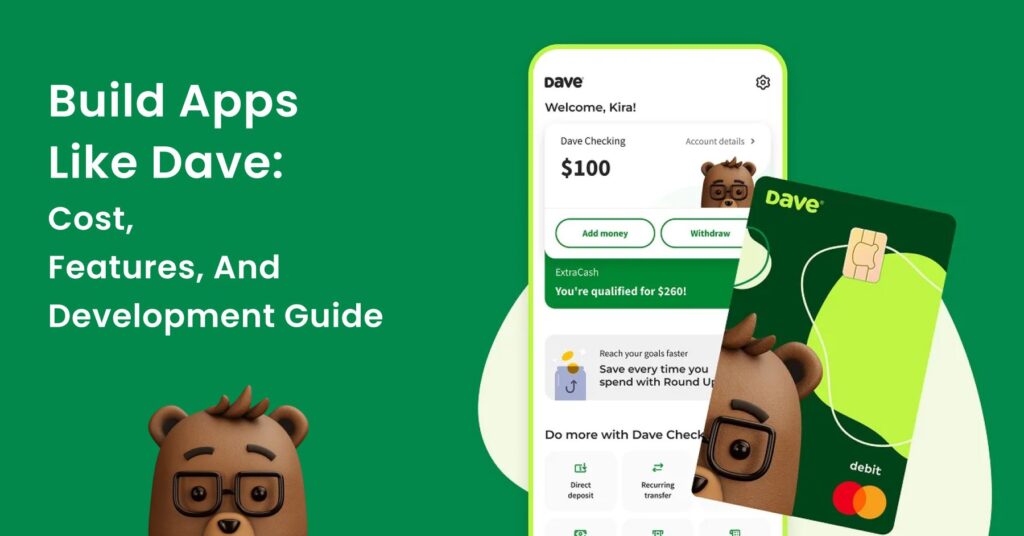
Imagine being $60 short three days before your paycheck hits. You can’t pay rent, you can’t fill your gas tank, and your bank just laughed at your overdraft balance. That’s exactly the gap apps like Dave were built to fill – and it’s a gap that millions of Americans face every single month.
Dave launched in 2017 with a simple promise: give workers early access to their earned wages without the triple-digit APRs that come with payday loans. Today, the app has over 10 million members, and the fintech space around it has exploded. Competitors like Earnin, Brigit, MoneyLion, and Chime are racing to grab their slice of the $21 billion earned wage access market projected for 2028.
So, what does it take to build apps like Dave in 2026? Whether you’re a startup founder, a fintech developer, or a product manager exploring this space, this guide breaks down everything – features, architecture, cost, regulations, and the path to launch.
What Makes Apps Like Dave So Popular in 2026?
The appeal of cash advance apps like Dave isn’t complicated. They solve a very real, very immediate problem: the gap between when people work and when they get paid. Traditional banks have been slow to adapt, still running on bi-weekly payroll cycles while app users need money now.
According to a 2024 survey by the Federal Reserve, nearly 37% of American adults couldn’t cover a $400 emergency expense using savings alone. That’s more than one in three people who need exactly what money apps like Dave provide.
Key Reasons for the Surge in Demand
- Zero-interest cash advances of $25 to $500 available within minutes
- No credit check required – ideal for users with thin or poor credit files
- AI-driven budgeting tools that predict when users might overdraft
- Side-hustle features connecting users with gig work opportunities
- Low or no monthly subscription fees (Dave charges just $1/month)
- Seamless integration with direct deposit and bank accounts
This combination of accessibility, speed, and low cost has made loan apps like Dave a go-to financial tool for gig workers, students, and hourly employees across the country.
Core Features to Include in Apps Like Dave
If you want to build a competitive product in this space, you need to understand what features define the best cash advance apps like Dave. Here’s a breakdown by category.
1. Cash Advance Engine
The headline feature. Users connect their bank account, the app analyzes their income pattern, and offers a cash advance up to a set limit – often $25 to $500. Repayment is automatically deducted on the next pay date. Key technical components include:
- Bank account aggregation via Plaid or MX Technologies
- Income verification and pay schedule detection using ML models
- Advance eligibility scoring (rule-based or AI-driven)
- Automated repayment and retry logic
2. ExtraCash / Overdraft Protection
Dave’s ExtraCash feature gives users a buffer before they hit a negative balance. For instant cash apps like Dave, this real-time monitoring is essential. It requires persistent monitoring of bank balances and push notification triggers.
3. Budgeting and Spending Insights
Money apps like Dave include robust personal finance tools. Transaction categorization, monthly spending summaries, and predictive alerts keep users engaged beyond the cash advance feature alone. This is also how you build retention and reduce churn.
4. Side Hustle Marketplace (Optional but Powerful)
Dave’s Side Hustle feature connects users to gig work through partners like Bluecrew and Wonolo. This feature differentiates the app from simple payday loan apps like Dave and adds a meaningful revenue stream through referral partnerships.
5. Dave Banking / Spending Account
Many money lending apps like Dave now offer full banking functionality – FDIC-insured accounts, debit cards, early paycheck deposits, and fee-free ATM networks. This dramatically increases user lifetime value and opens up interchange revenue.
Feature Comparison Table
| Feature | Dave | Brigit | Earnin | MoneyLion |
|---|---|---|---|---|
| Cash Advance | Up to $500 | Up to $250 | Up to $750 | Up to $500 |
| Monthly Fee | $1 | $9.99 | Free | $1–$19.99 |
| Credit Check | No | No | No | No |
| Banking Account | Yes | No | No | Yes |
| Side Hustle Tool | Yes | No | No | No |
| Credit Building | No | Yes | No | Yes |
Technical Architecture for Building Lending Apps Like Dave
Building instant cash apps like Dave requires a secure, scalable, and compliance-ready architecture. Here’s what your tech stack needs to look like in 2026.
Frontend
- React Native or Flutter for cross-platform iOS and Android development
- Responsive UI with biometric login (Face ID/fingerprint)
- Real-time balance and transaction feeds
- Push notifications for advanced eligibility and repayment reminders
Backend
- Node.js or Python (Django/FastAPI) for the core API layer
- PostgreSQL or MySQL for transactional data
- Redis for session management and real-time caching
- Kafka or RabbitMQ for event-driven architecture (e.g., bank sync events)
Read Also: How to Develop a Cloud Application?
Key Third-Party Integrations
| Integration | Purpose | Example Providers |
|---|---|---|
| Bank Connectivity | Account linking and balance reads | Plaid, MX, Finicity |
| KYC / Identity | Identity verification and fraud prevention | Alloy, Persona, Jumio |
| Payment Rails | ACH transfers, RTP, instant disbursement | Dwolla, Stripe, Synapse |
| Core Banking | Issuing debit cards and accounts | Bankable, Unit, Synctera |
| Analytics | User behavior and advanced models | Amplitude, Segment, Mixpanel |
| Cloud Infrastructure | Hosting and scaling | AWS, GCP, Azure |
Security and Compliance Requirements
This is where many fintech startups underestimate the work involved. Money borrowing apps like Dave operate in a heavily regulated environment. Your app must address:
- PCI-DSS compliance for handling payment card data
- SOC 2 Type II certification for enterprise-level security assurance
- GLBA compliance for protecting consumer financial data
- State-by-state lending license requirements (vary significantly)
- CFPB’s Earned Wage Access guidance (updated in 2024)
- End-to-end encryption, MFA, and anomaly detection systems
Pro Tip: Work with a fintech-specialized legal counsel from day one. Earned wage access regulation varies by state, and getting this wrong can mean fines or forced shutdowns.
Development Cost Breakdown
| Development Phase | Estimated Cost (USD) | Timeline |
|---|---|---|
| Discovery & Architecture | $15,000 – $30,000 | 4–6 weeks |
| MVP (Core Features Only) | $80,000 – $150,000 | 4–6 months |
| Bank Integration (Plaid, etc.) | $20,000 – $40,000 | 6–8 weeks |
| KYC / Compliance Layer | $25,000 – $50,000 | 6–10 weeks |
| Banking / Card Issuance | $40,000 – $80,000 | 8–12 weeks |
| QA and Security Audits | $20,000 – $35,000 | 4–6 weeks |
| Total MVP Estimate | $200,000 – $385,000 | 9–14 months |
Ongoing Monthly Costs
- Cloud infrastructure: $3,000 – $15,000/month (scales with users)
- Plaid API fees: $0.30 – $0.50 per user per month
- KYC verification: $0.50 – $2.00 per verified user
- Customer support staffing: $10,000 – $30,000/month
- Compliance and legal retainer: $5,000 – $15,000/month
- Marketing and user acquisition: Variable – $10–$30 CAC is realistic
Total burn rate for an early-stage money loan apps like Dave product typically runs $50,000 – $120,000/month before reaching profitability. Runway planning is critical.
Revenue Models for Cash Advance Apps Like Dave
Dave itself turned profitable in 2023 by diversifying its revenue beyond the subscription model. Here are the monetization strategies to consider for your lending apps like Dave.
- Subscription Fees: Monthly membership ($1–$10/month). Simple and predictable, but it creates a barrier during onboarding.
- Instant Transfer Fees: Free ACH transfers take 1–3 days; users pay $1.99–$4.99 for instant delivery. This is a major revenue driver – Dave reportedly earns more from tips and express fees than from subscriptions.
- Tips / Voluntary Contributions: Dave pioneered the ‘tip’ model, where users can optionally tip up to 25% of their advance. While controversial, it’s effective and legally simpler in many states.
- Interchange Revenue: Debit card spending generates 1–2% interchange fees. With a large user base making daily purchases, this adds up fast.
- Banking Partnerships: Referral fees for financial products (loans, insurance, investing) embedded in the app.
- Premium Tiers: Offering higher advance limits, credit-building tools, or investment accounts behind a paid tier.
Step-by-Step Guide to Launching Your App Like Dave
Step 1: Define Your Niche and ICP
Don’t try to be everything. Are you targeting gig workers? Healthcare workers with irregular pay? College students? Your ideal customer profile (ICP) shapes everything — the advance amounts, the UI, the marketing channels, and the compliance pathway.
Step 2: Secure Your Banking Partner and Licensing
This is the most underestimated step. You’ll need a banking-as-a-service (BaaS) partner like Unit, Synapse, or Treasury Prime to issue accounts and move money. You’ll also need to assess whether your product requires state lending licenses or can operate under the bank’s charter.
Step 3: Build the MVP with Core Advanced Logic
Focus on the cash advance flow first. Bank connection → income verification → advance offer → disbursement → repayment. Get this loop tight and reliable before adding bells and whistles.
Step 4: Integrate KYC and Fraud Prevention
Every user must be verified. Synthetic identity fraud is a massive problem in the earned wage access space. Invest in multi-layer fraud detection from day one – it’s far cheaper than managing defaults and fraud losses later.
Step 5: Closed Beta and Iterative Testing
Launch to 1,000–5,000 invited users before going public. Monitor advance repayment rates, fraud patterns, and customer support volume. Your default rate target should be under 3% for the model to be sustainable.
Step 6: Scale with Growth Channels
Dave grew partly through employer partnerships – offering the app as an employee benefit. Other effective channels include TikTok financial content, influencer partnerships, and referral programs with $5–$15 bonuses. Your CAC will make or break unit economics.
Read Also: What Is Sotwe?
Regulatory Landscape for Payday Loan Apps Like Dave in 2026
The regulatory environment has shifted significantly. In 2024, the CFPB finalized guidance classifying many earned wage access products as credit, triggering new disclosure requirements across the industry. Here’s what you need to know:
- California, New York, and Illinois have the strictest earned wage access regulations — expect licensing requirements and rate caps
- The CFPB’s 2024 interpretive rule requires Truth in Lending Act (TILA) disclosures for products with fees or tips
- ‘True lender’ doctrine challenges mean your BaaS bank relationship needs careful structuring
- Anti-money laundering (AML) and Bank Secrecy Act (BSA) compliance is non-negotiable
- State money transmitter licenses may be required, depending on your disbursement model
Dave, Earnin, and Brigit have all navigated regulatory challenges. Learning from their legal history – including Earnin’s 2019 CFPB inquiry – will save you significant pain and cost.
Final Thoughts: Is 2026 a Good Time to Build Apps Like Dave?
Absolutely – but the window for a ‘me too’ product is closing. The earned wage access market is maturing fast, and the companies winning in 2026 are those with a clear niche, strong unit economics, and genuine user trust.
The $21 billion market opportunity is real, and traditional banking still leaves tens of millions of Americans underserved. But building in this space requires more than a slick UI and a Plaid integration. You need a defensible compliance strategy, a fraud-resistant underwriting model, and a user acquisition engine that brings your CAC below $25.
If you’re serious about launching a cash advance app like Dave, start with the regulatory landscape in your target states, find a BaaS partner early, and build your MVP around the cash advance loop before layering in banking, credit building, and marketplace features.
FAQs
Q1: What’s the difference between cash advance apps like Dave and payday loans?
Payday loan apps like Dave and traditional payday lenders serve a similar need – bridging a cash gap before payday – but the mechanics are very different. Dave and similar apps typically charge no interest, automatically recover funds on your pay date, and often charge only a small monthly subscription fee or an optional tip. Traditional payday lenders charge fees that equate to APRs of 300%–400%. The CFPB treats them differently from a regulatory standpoint, though this distinction has been narrowing since 2024.
Q2: How much money can you typically get from money borrowing apps like Dave?
Most cash advance apps, like Dave, offer between $50 and $500 to new users. Dave itself offers up to $500 through its ExtraCash feature. Apps like Earnin can go up to $750, while Brigit caps at $250. The amount is based on your verified income, spending history, and how long you’ve been a member. Regular users with consistent direct deposit often see higher limits over time.
Q3: Can I build an app like Dave without a banking license?
Yes, but you’ll need a banking-as-a-service (BaaS) partner that is itself a licensed bank. Platforms like Unit, Synapse, and Treasury Prime enable fintech startups to offer financial products under a partner bank’s charter. However, you may still need a money transmitter license in certain states, and if the CFPB classifies your product as credit, you’ll need to provide Truth in Lending disclosures regardless.
Q4: How long does it take to develop a money lending app like Dave?
A fully functional MVP for a money lending app like Dave typically takes 9 to 14 months from kickoff to launch, assuming a team of 8–12 engineers, designers, and compliance specialists. The largest time investments are bank integration, KYC/fraud systems, and regulatory review. Skipping corners here is not advisable – the compliance and security layers are what protect you from fraud losses and regulatory fines.
Q5: What tech stack do most instant cash apps like Dave use?
Most modern lending apps like Dave are built with React Native or Flutter for mobile and a Node.js or Python backend. Bank connectivity typically runs through Plaid or MX Technologies. Cloud infrastructure is usually AWS or GCP. For payments, ACH via Dwolla or Stripe Treasury is common, with real-time payment (RTP) options becoming increasingly standard for instant disbursement.
Q6: What’s the realistic default rate for cash advance apps?
Industry benchmarks for money apps like Dave suggest default rates between 1% and 5%, with best-in-class apps maintaining under 3%. Your default rate depends heavily on the quality of income verification, the advance limits relative to your income, and your repayment retry logic. This is why ML-based underwriting – even simple rule-based scoring – is essential from day one.