
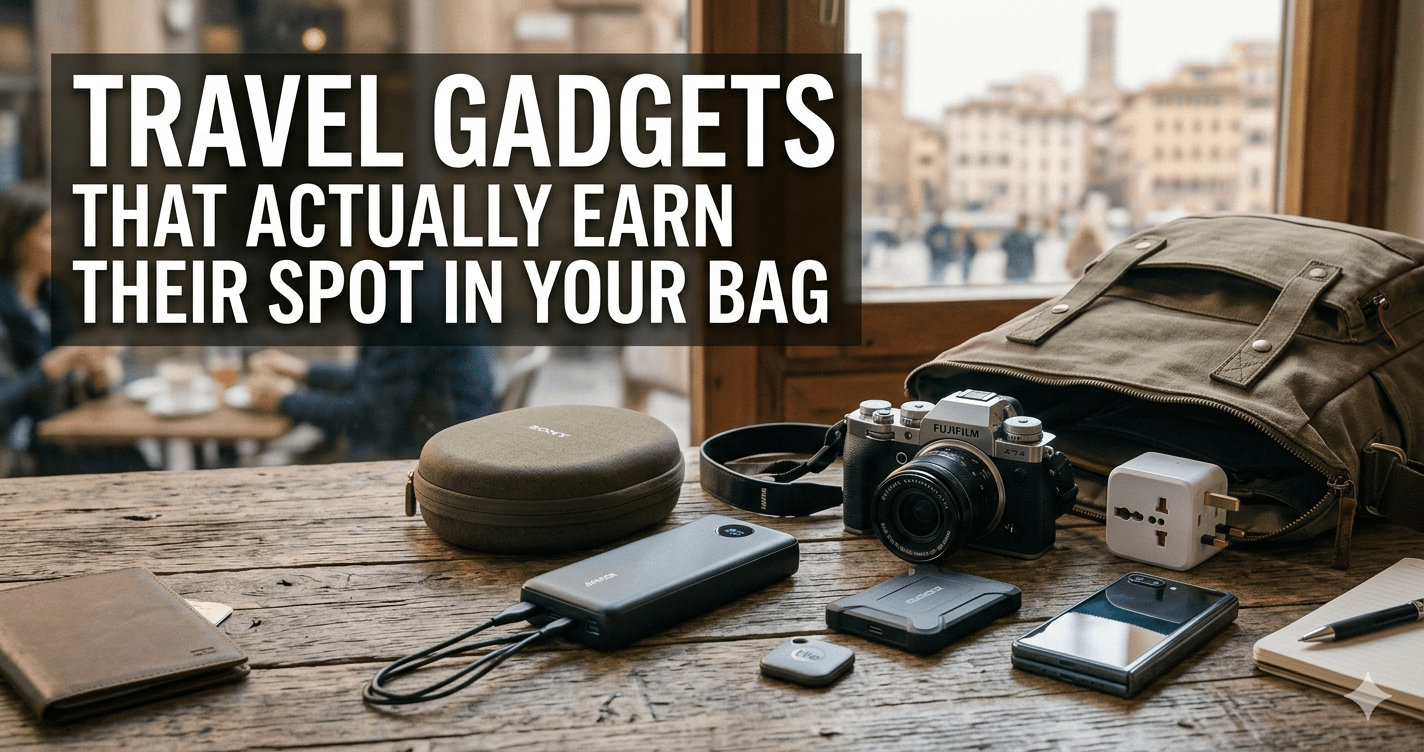
I’ve got a drawer at home. It’s full of travel gadgets I bought on impulse and used exactly once. A vibrating neck pillow. A “smart” suitcase that died after one trip. Some weird folding cup. A pair of slippers that came in their own tiny zippered house. The whole graveyard.
So when I talk about travel gadgets here, I’m trying to keep that drawer out of yours. This isn’t a list of every shiny thing on Amazon. These are the ones I actually grab when I’m packing, the ones that have survived enough flights, hostel beds, missed connections, and overnight buses to deserve the suitcase real estate.
Let’s get into it
Why bother with travel gadgets at all?
Honest answer? Most of them are pointless. The good ones, though, solve a specific kind of misery that travel keeps throwing at you. Dead phone in a foreign train station. Hotel Wi-Fi that won’t load. A baggage handler who decided your suitcase needed to learn humility. The right gadget removes one small headache, which over a two-week trip adds up to roughly your sanity.
The category has changed a lot in the last couple of years, too. Chargers got tiny because of GaN chips. Tracker tags went mainstream after enough people watched their suitcases fly to a different continent. Universal adapters stopped being the size of a brick. Power banks finally figured out wireless. eSIMs killed the airport SIM-card kiosk. If your “travel gadget” rotation is still running on 2019 gear, you’re carrying twice the weight for half the function.
I also want to say up front: I’m not going to pretend that any single product is life-changing. Travel gadgets aren’t life-changing. They’re paper cuts you’ve decided to stop bleeding from. That’s it. That’s the value prop.
The Travel Gadgets I’d Actually Recommend in 2026
1. A GaN universal adapter (the one gadget I forget at my peril)
If you only buy one thing off this list, make it a decent universal adapter with GaN technology. The TESSAN 65W is the one I keep going back to it handles US, UK, EU, and AU outlets in a single block, has USB-C PD and USB-A ports, and will fast-charge a laptop without melting itself.
What changed: older adapters used silicon, which meant heavy, hot, and slow. GaN (gallium nitride, if you want to sound clever at dinner) runs cooler and packs more power into a smaller body. My current one is roughly the size of a deck of cards and replaces three separate chargers plus a region-specific plug. Around $40. Pays for itself the first time you’d otherwise stand in a Heathrow shop paying £25 for a plug you’ll lose in a week.
One thing to check: not all “universal” adapters are actually universal. Some skip the South African socket, which is a problem if you’re going to South Africa. Read the box.
2. A magnetic power bank that doesn’t pretend to be something else
Anker’s 10,000 mAh MagSafe-compatible power bank snaps onto the back of an iPhone and starts charging wirelessly. No cable. That sounds like a small thing until you’re standing in a customs line for two hours and your phone is at 4%.
Two charges’ worth of capacity, a built-in kickstand for propping the phone up on a tray table (this is huge for in-flight movies if your seat doesn’t have a screen), and pass-through USB-C charging so you can power both the phone and the device from a single cable. Slim enough to stack against the phone in your pocket. The Android equivalents are catching up fast – Baseus and UGREEN both make solid Qi2 versions now, and Samsung’s own magnetic case-and-pack system is finally not embarrassing.
A note: if you’re flying, keep power banks in your carry-on, not your checked bag. Almost every airline requires this, and the fines are not fun. Also, 100Wh is the rough ceiling most carriers allow, which translates to roughly 27,000 mAh. Anything bigger needs special permission.
3. AirTags or Tile (or whatever you Android people use)
I’ve never lost a bag. I also never used to wear a seatbelt in cabs in my twenties. Both feelings, invincibility and luck, eventually run out.
An AirTag in your checked suitcase costs $25 and gives you something to point at when an airline agent insists your bag is “definitely in Madrid.” Last year, a friend watched hers ping at JFK while she was in Lisbon. The airline put it on the next flight because she had screenshots. Before AirTags, that conversation goes very differently.
For Android, the Chipolo POP works with both Google’s Find My Device network and Apple’s, which is genuinely useful if you’re a mixed-platform household. Pebblebee makes a card-sized version that fits in a wallet, which is the kind of thing you don’t think you need until your wallet falls out of your pocket in a cab.
Toss one in your suitcase, slip another into your laptop bag, and call it cheap insurance. The four-packs work out to about $20 each, which is less than what airlines now charge for the privilege of bringing your second pair of shoes.
4. Noise-canceling earbuds
This is where opinions get loud. The Bose QuietComfort Ultra Earbuds are the gold standard — the noise canceling on planes is honestly absurd, like someone turned the engine off. Six hours of battery, slim enough to sleep on your side without your ear screaming.
Sony’s WF-1000XM5 and the AirPods Pro 2 are right there, too. I lean toward Bose for long-haul because the seal blocks the low-frequency drone better than anything else I’ve tried, but if you’re already in the Apple ecosystem, the AirPods Pro’s spatial audio for movies and seamless device switching probably wins. The Sonys split the difference and tend to be on sale more often, which counts for something.
The thing nobody tells you about ANC earbuds: they’re not just for music. Pop them in with nothing playing, and the cabin gets noticeably less awful. You’ll be less tired when you land, even if you didn’t listen to a single song. That’s the actual feature.
If over-ear is more your thing, the Bose QC Ultra Headphones and Sony WH-1000XM6 are both excellent, just bulkier in a carry-on. Pick your poison.
5. A travel router (yes, really)
This one took me a while to come around on. A travel router sounds like overkill until you’ve watched hotel Wi-Fi ask you to log in separately on your phone, laptop, watch, and tablet — six times in two days, twice per day, with a 90-minute session timeout that resets in the middle of a Zoom call.
The Ubiquiti UniFi Travel Router is the current darling. It sits between your gear and whatever messy network you’re connecting to, you log in once, and everything else just works. Built-in WireGuard VPN tunnels your traffic back home so your Netflix doesn’t suddenly think you’ve moved to Croatia. It’s the size of a pack of cards, USB-C powered, around $79.
GL.iNet makes cheaper versions in the $30-50 range that are easier on the wallet if you’re not all-in on the UniFi ecosystem. Same idea, slightly less polish, often a better fit for casual travelers.
If you’re traveling somewhere with truly questionable cellular coverage, or you want a single device that handles roaming, Wi-Fi sharing, and even satellite fallback, the newer 5G mobile hotspots like the G50 Max are wild. 5G roaming in 80+ countries, in-flight Wi-Fi support, and NTN satellite when you’re somewhere the cell towers aren’t. Probably overkill for a beach trip. Genuinely useful for digital nomads, journalists, and anyone whose income depends on being online.
Related Blog: iPhone vs Samsung: Which Smartphone Brand is Better in 2026?
6. A real charging brick (not the cube that came with your phone)
Apple stopped including chargers. So did Samsung. So now everyone travels with the 5W cube their phone shipped with five years ago and wonders why nothing charges.
Get a 65W or 100W GaN charger with at least two USB-C ports. The Anker Nano II, UGREEN Nexode, and Baseus 100W all do the job. One brick charges your laptop, phone, and earbuds simultaneously. You’ll only need one outlet, which matters in old hotel rooms where outlets are a scarce resource, hidden behind the bed or, my personal favorite, installed exclusively inside the bathroom for reasons no architect has ever explained.
A 100W charger will run a MacBook Pro at full speed. A 65W is enough for a MacBook Air or most ultrabooks. If you’re not traveling with a laptop, a 45W brick is fine and cheaper.
7. A foldable charging station (the underrated one)
Different angle on the same problem: a fold-flat wireless charging pad that charges a phone, watch, and earbuds at once from a single outlet. Travel versions from Belkin, Nomad, and Anker collapse into something the size of a paperback. The first night in a hotel where you don’t have to play outlet Tetris is genuinely emotional.
Mophie’s 3-in-1 travel charger is the polished option. Anker’s MagGo 3-in-1 is the better value. Either way, you’re consolidating three cables and three plugs into one object. The savings in bag space alone are worth it for trips over a week.
8. A Kindle (or any e-reader, honestly)
I know, I know. You like the smell of books. I do too. But you can’t carry six paperbacks in a carry-on without it becoming the only thing in the carry-on.
The base Kindle is fine. The Paperwhite is better. The Kobo Libra Color is what I’d actually buy if I were starting over — open ecosystem, page-turn buttons, library books load directly via OverDrive. The battery lasts weeks. Doesn’t glare at the beach. The screen doesn’t tempt you to check Slack at 11 p.m. in a hotel bed, which is more valuable than most apps.
If you take notes while you read or you do a lot of work on the road, the Kindle Scribe is the upgrade pick. Color e-ink, Apple Pencil-style stylus, magazine layouts that actually look like magazines. Heavier and pricier, but if it replaces your notebook too, it earns its weight.
9. A digital luggage scale (cheapest useful gadget on the list)
About $12. Hooks onto a handle. Tells you the weight before you get to the desk, only to discover you’re four pounds over and now owe the airline $90.
I used to wing it. I don’t anymore. Last year alone, this thing saved me about $200 in overweight fees on a single trip to and from Bangkok with too many souvenirs. It runs on a coin cell that lasts roughly forever and weighs nothing. Etekcity makes the one I use. There are fifty identical-looking versions under different brand names; any of them is fine. Don’t overthink this.
10. Packing cubes and a cable organizer
Not technically a gadget. I don’t care. Packing cubes are the single biggest jump in pack quality you can make. Eagle Creek, Peak Design, and Bagsmart are all fine. Use one per category (shirts, underwear, electronics) and stop having to repack from scratch every morning.
The compression cubes are the move for trips longer than a week. You stuff clothes in, zip the second zipper, and watch a small miracle as the cube shrinks by 30%. Suddenly, you can fit a second pair of jeans without splitting your suitcase.
For cables specifically, Moment’s Tech Organizer is a zippered pouch with elastic loops and structured pockets. Sounds dumb. Is actually transformative. On day three of any trip, every cable, dongle, and adapter you own would otherwise be a Gordian knot at the bottom of your bag. This stops that. Bellroy and Bagsmart make similar ones at lower prices. Pick a color you can spot in a dark hotel room.
11. A travel pillow that doesn’t lie
Most travel pillows are scams. They look supportive in the store, and then your head still bobs forward, and you wake up with a neck that won’t turn left for two days.
The Cabeau Evolution X is the one I keep going back to. Dual-density memory foam, raised side supports that actually keep your head from falling sideways, and compress slightly. The TRTL Pillow Cool is another strong option if you sleep hot — it wraps around your neck like a scarf, with hidden internal support, and looks weird but works.
The Ostrichpillow Go is this year’s cult favorite if you want a bit more wrap-around coverage. All three are better than whatever inflatable thing you got at the airport. None of them is cheap, and that’s the point. You’re paying for the one that works.
12. A sleep mask with built-in headphones
Combines two carry-on items into one. The built-in headphones are slim enough to lie on your side without crushing your ears, and they play whatever you want – podcasts, white noise, sleep apps – without earbuds. For overnight flights, it’s the difference between waking up rested and waking up like you ran a marathon.
The Manta Sleep Mask Sound and the MUSICOZY are the two I’ve tried that don’t fall apart after a month. Both block out 100% of light (the trick is the deep eye cups, which also let you blink freely — an underrated feature). Pair with a melatonin, and you’ve basically gamed your way through an overnight flight.
13. Compression socks (boring, important)
I avoided these for years because they felt like an “I am old now” purchase. Then I did a 32-hour door-to-door trip, and my ankles looked like bread loaves.
Get 15-20mmHg graduated compression – strongest at the ankle, easing toward the calf. Bombas, Comrad, and Sockwell all make versions in merino blends that don’t make your feet sweat. Wear them for anything over five hours. Your legs will be smug.
A second use case: long bus rides through mountains. Same physics, same swelling, same misery. Toss a pair in your day bag.
14. A portable espresso maker (yes, this is the one indulgent gadget)
Hotel coffee is bad. Hostel coffee doesn’t exist. Café coffee at 7 a.m., when you have a train, means showering at 5:30.
The OutIn Nano is a thermos-sized electric espresso machine that runs on USB-C. Add water, add ground coffee, push a button, and get something genuinely close to espresso in three minutes. The Wacaco Nanopresso is the manual version if you don’t want batteries — you pump the pressure yourself, and it weighs almost nothing.
The MokaMax is the newer entry – a rigid stainless travel mug with a pressure brewer built into the body. Fill it, add grounds, press the mechanism, and drink straight from the mug. No separate parts to lose in a hostel kitchen, which is the failure mode that killed my last two travel coffee setups.
Niche, expensive, totally indulgent. I love it.
15. A microfiber towel
The least exciting item on this list. Also, the one I actually use most. Wipe down wet shoes, dry your hair when the hotel only gives you one towel, mop up the coffee you spilled in your bag, wash a dog’s paws (long story). Folds smaller than a phone. Dries faster than you’d think. Five bucks.
The Matador NanoDry is the premium version – it comes in a silicone case, so it doesn’t make your other clothes damp. Worth the upgrade
If you ever swim, camp, or get caught in unexpected rain (so, all travelers).
16. An eSIM (the gadget that isn’t a gadget)
Including this because most people still don’t use them. eSIMs from Airalo, Holafly, or Saily let you land in a country with data already working. No SIM swap, no airport kiosk, no “what’s my country code” calls home. You install the plan before the flight, switch it on when you land, and skip the part where everyone else pays $15/day for roaming.
For most short trips, $5-15 gets you enough data for the whole week. For longer or multi-country stays, regional plans (Europe-wide, Asia-wide) still work out cheaper. The catch: not all phones support eSIM yet, and some carriers lock the feature. Check before you fly.
17. A smart luggage tag with an alarm
The Knog Smart Luggage Tag is interesting – it works like an AirTag with Apple’s Find My network, but adds an 85dB motion-sensitive alarm. Translation: if someone grabs your bag off the carousel, it screams. Useful in places where bag theft is a real risk. Also helpful if you’re the kind of person who walks away from luggage at airport food courts (you shouldn’t, but you do).
18. A foldable handheld fan
I put this in the “I’ll never use this” bucket for years. Then I spent a summer in Southeast Asia with no breeze and a humidity reading I’d rather not repeat. Now I carry one. The AOKIYURI and JISULIFE models both fold flat, charge over USB-C, and run for hours on a single charge. For hot-weather travel, museums without air conditioning, or any kind of waiting in line outdoors, it earns its space.
What I’d skip
Out of fairness, the list of travel gadgets I think are mostly a waste of money:
Smart suitcases with built-in batteries – most airlines have weird rules about them now, the batteries die or break before the suitcase does, and you can’t remove the battery on a lot of models. Buy a normal good suitcase and a separate power bank.
Travel “gadget” multi-tools with sixteen functions – you’ll never use fifteen of them, and the one you need will be terrible at its job.
Anti-theft backpacks with hidden pockets that any thief who’s seen one before knows exactly where to look. A normal backpack that you don’t leave unattended is better.
Sleep aid gadgets that “stimulate” anything. Just take melatonin and put on the eye mask.
Silicone collapsible water bottles, despite what every list says. They taste like silicone for the first month. By the time they don’t, you’ve lost one. A regular metal bottle is fine.
Silicone travel kettles – saw a wave of these go viral. They work, technically, but most hotels have a kettle anyway, and the ones that don’t usually have a coffee machine you can hijack for hot water. Skip it.
Choosing gadgets for the kind of trip you actually take
I see a lot of lists that pretend everyone travels the same way. They don’t. Quick, honest sort:
If you’re doing long-haul flights, the priorities are noise-cancelling earbuds, a real travel pillow, compression socks, and a charged power bank. Everything else is secondary. You’re trying to survive 12+ hours in a chair designed by someone who clearly never sat in one.
If you’re working on the road, the travel router and a fast laptop charger matter way more than the espresso maker. Hotel Wi-Fi will be your enemy at least once per trip, and “I’ll just use the hotspot” is the lie you tell yourself before you watch your phone battery drain in 90 minutes.
If you’re traveling to multiple countries, the universal adapter, eSIM, and luggage tracker move to the top of the list. You’ll be constantly plugging into new outlets and networks, and there’s nothing more “you’ve messed up” than landing in a new country with no working SIM and a dead phone.
If you’re packing light (backpacker, single carry-on type), the digital scale, packing cubes, and microfiber towel earn their keep more than anything fancier. You’re optimizing for weight, not features.
If you’re shopping for gadgets for travelers as gifts, the safe bets are the AirTag four-pack, a Kindle, or the Anker MagSafe power bank. Hard to go wrong with any of those. For the more specific traveler in your life: the OutIn Nano espresso maker if they’re a coffee snob, the Cabeau pillow if they fly often, the Knog tag if they’re forgetful.
A few last thoughts
The best travel gadgets share something in common: they fix a specific recurring annoyance you’d otherwise just accept. Dead phone. Lost bag. Bad pillow. Knotted cables. Bad coffee. None of them is exciting. All of them are quietly excellent at one job.
Don’t try to buy the whole list. Pick the two or three that match the kind of misery your trips usually involve, get good versions, and let the rest go. The traveler with five gadgets they actually use is having a better time than the one with twenty crammed into a packing cube.
A last tip, totally free: write down the gadgets you packed but didn’t use on your next trip. After two trips, the pattern is obvious — and it’s not the same for everyone. My pattern is that I never use the espresso maker on city trips, but I always use it on trains. Yours will be different. Adjust accordingly.
Then maybe – just maybe – your travel gadget drawer at home stays a little smaller than mine.