
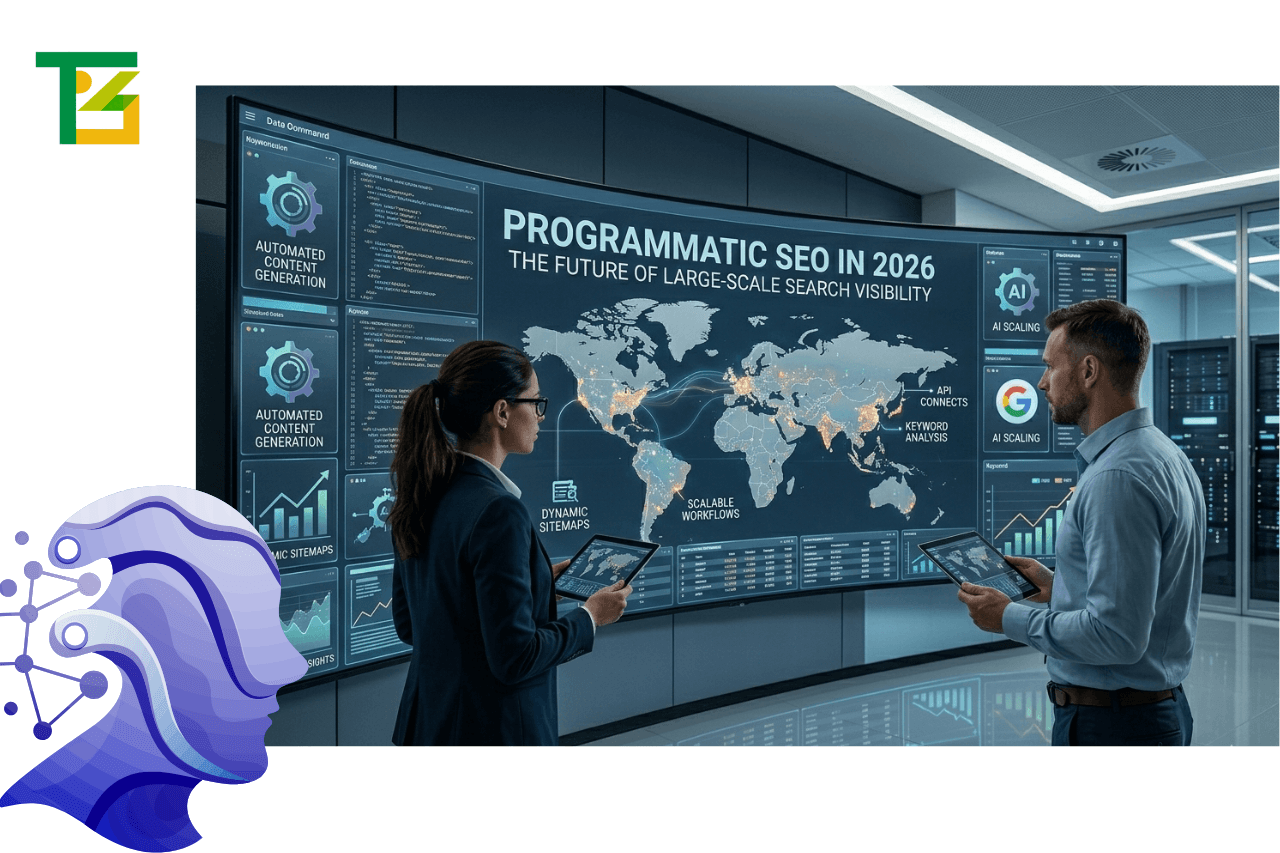
Quick Answer Programmatic SEO is not dead, but old-school pSEO is. Google’s May 21, 2026 Core Update (Gemini-powered) specifically targets template-fill content with thin variation. Sites with heavily programmatic content saw a 40–90% drop in traffic within 72 hours.
The new rule: every pSEO page must have ≥60% unique content, draw from 3+ data sources, pass the “Uniqueness Test,” and be structured for AI citation (GEO). Programmatic frameworks that produce genuinely unique, data-rich pages still work – and can dominate both Google search and AI Overviews in 2026.
Everything that changed from Google’s Gemini-powered May Core Update to the rise of GEO and AI Overviews. What died, what survived, and the new playbook that actually works.
What Is Programmatic SEO?
Programmatic SEO (pSEO) is the strategy of using structured data, templates, and automation to generate hundreds or thousands of landing pages that each target specific long-tail keyword combinations at a scale no human editorial team could match manually.
Think Zapier’s integration pages (“Connect Slack to Trello”), Zillow’s property listings, Nomad List’s city pages, or Wise’s currency conversion calculators. Each of these companies built organic traffic empires by systematically covering an entire keyword space with pages that answer real, specific user queries.
The Classic pSEO Formula (Now Under Pressure)
Variable A [City / Product / Keyword] + Variable B [Service / Year / Category] + Template Content = Page targeting long-tail keyword
Example: “Best plumbers in Austin”, “Best plumbers in Denver”, “Best plumbers in Seattle” – scaled to 500 cities using one template. This approach is exactly what Google’s 2024–2026 updates dismantled.
- 58% of US searches now result in zero clicks (AI answers directly)
- 40–90% traffic drop for thin pSEO sites after May 2026 update
- 30% of product research now happens on AI agents vs. Google
- 300%+ avg. traffic growth for quality-first pSEO implementations
Programmatic SEO: Every Major Update (2024–June 2026)
To understand where we are now, you need to see how we got here. Google’s stance on programmatic content shifted dramatically across this period.
rch 2024 Scaled Content Abuse Policy Introduced
Google’s March 2024 Core Update introduced a new spam category: “scaled content abuse,” defined as generating many pages where content differs only slightly, with the primary purpose of manipulating rankings. This was the first direct warning shot at pSEO practitioners.
August 2024 Helpful Content Architectural Shift
Google’s August 2024 Helpful Content Update wasn’t a minor tweak — it was a complete architectural shift that raised the E-E-A-T (Experience, Expertise, Authoritativeness, Trustworthiness) bar. Entire programmatic content sites that lacked firsthand expertise were buried.
March 2025 Pattern Recognition Sharpens
Quality-model-based assessment tightened further. Google’s directional commitment to penalizing template-fill content became unmistakable. The consistent pattern across updates is that each one specifically demoted programmatic pages with low per-page variation.
June 2025 AI Overview Expansion Accelerates
Google’s second broad core update of 2025 coincided with a massive expansion of AI Overviews. Click-through rates for traditional top-10 results dropped by 58% when an AI Overview was present. Zero-click search became the dominant paradigm.
August 2025 Spam Detection Goes AI-Native
Google’s August 2025 Spam Update deployed AI-native spam detection for the first time. Google’s crawlers became ruthlessly efficient at identifying “boilerplate” content pages that only change one or two words from a template, which were flagged automatically at scale.
December 2025 Authority Signals Deepen
18-day rollout completing December 29. Focus: improving relevance, quality, and reliability. Sites with helpful, authoritative, people-first content gained; those relying on thin or outdated content declined. Reinforced trends from 2024–2025.
February 2026 Discover Surface Personalization Overhaul
A new chapter in Google’s efforts to make personalized surfaces more useful. Significantly affected traffic for content-heavy sites reliant on Discover. Emphasized real value and alignment with user preferences over purely SEO-optimized material.
March 24–25, Quick Cleanup Operation
Completed in under 20 hours, notably fast. Targeted scaled content abuse patterns identified since March 2024. Sites that had pivoted to quality-first pSEO were largely unaffected.
May 2026 Core Update: Gemini-Powered Quality Model
The update that changed everything. A Gemini-powered overhaul targeting automated, ad-bloated content. Within 72 hours, programmatic SEO operators reported traffic drops of -40% to -90%. This is the current state of programmatic SEO as of June 2026.
Google’s May 2026 Core Update: What Actually Happened
Critical Alert Google’s May 21, 2026 Core Update is the most significant algorithm change for programmatic SEO since the original Helpful Content System. If you run pSEO pages, you need to audit them immediately.
On May 21, 2026, Google began rolling out a Gemini-powered quality model overhaul, the second broad core update of 2026, and arguably the most consequential update for programmatic SEO practitioners in years.
The update specifically targets four patterns that have been defined as low-quality programmatic SEO:
Template-fill programmatic content
City × service, year × keyword, location × product patterns, where the variable parts make up 80%+ of the page while the static parts are generic. Google’s Gemini model can now distinguish this from genuinely original pages at scale.
Automated content without editorial oversight
AI-generated content that was published with little editing, expertise, or originality. The content itself isn’t the issue — the lack of human verification and depth is. Pages created primarily around keyword opportunities rather than user needs are being demoted.
Ad-bloated programmatic pages
Pages where the ad density exceeds the actual content value. The Gemini quality model evaluates whether a page “genuinely satisfies search intent rather than simply targeting keywords correctly.”
Websites publish random, unrelated topics for traffic
Topical authority is now non-negotiable. Websites that scatter across unrelated niches to capture keyword traffic are losing authority signals throughout their domains.
“Google’s Gemini-powered quality models can now distinguish, at scale, between programmatic templates with thin variation and genuinely original pages. Until 2024, the cost of evaluating every URL for ‘is this template-fill?’ was prohibitive. Now it isn’t.”
Schema & Structured Data After the May 2026 Update
Brands that aligned their on-page strategy with Google’s quality benchmarks, including structured data and clear internal linking, reported up to 34% more organic traffic in the first month after the May 2026 update.
The key insight from post-update data: Pages ranking for competitive informational keywords without FAQ schema, Article schema, or any structured data were hit particularly hard. Sites with comprehensive schema markup, complete author markup, datePublished/dateModified fields, and FAQPage schema largely held their positions or improved.
Schema.org v30.0 Validation RequiredPost-I/O 2026, validate existing schemas against v30.0. Run your structured data through both validator.schema.org and Google’s Rich Results Test. Note: FAQ rich result eligibility narrowed in March 2026, FAQ schema now primarily functions as an AI trust signal rather than a SERP display trigger.
What Died in 2026: The pSEO Tactics That No Longer Work
Let’s be direct about what the 2024–2026 Google updates eliminated. If you’re still running any of these strategies, you’re actively losing rankings.
| Tactic | Status | Why It Died |
|---|---|---|
| Pure variable substitution “Best [service] in [city]” with only the location changing |
Dead | Gemini quality model identifies template-fill at scale; 80%+ static content pages deindexed within days |
| AI-generated content without oversight Bulk-generated pages with no human review |
Dead | Lacks depth, firsthand experience, and practical usefulness — all E-E-A-T requirements |
| Doorway pages Thin landing pages designed purely to funnel traffic |
Dead | Classified as “scaled content abuse” since the March 2024 Spam Policy update |
| Ad-bloated pSEO High ad density relative to content value |
Dead | Explicitly targeted by May 2026 Core Update “automated, ad-bloated content” language |
| Single-source data pages Pages pulling from only one data API or dataset |
Risky | The new standard requires ≥3 data sources per page for credibility signals |
| Topical scatter publishing Publishing across unrelated niches for keyword coverage |
Risky | Topical authority is now a domain-level signal — unrelated content weakens it |
- Pages where removing the city/keyword variable makes the rest of the content useless
- pSEO pages without verified author attribution and E-E-A-T signals
- Templates without dynamic sections (images, FAQs, CTAs that adapt per page)
- Programmatic content published without a human-in-the-loop review process
What Still Works: The pSEO Strategies Thriving in 2026
Good News Bad programmatic SEO is dead not programmatic SEO itself. Companies like Zillow, Wise, Nomad List, and Flyhomes (which scaled from 10K to 425K pages) continue to dominate because their pSEO produces genuinely unique, data-rich pages per URL.
The Uniqueness Test – The Single Most Important Rule
Ask yourself: “If I removed the city name / variable keyword from this page, would the rest of the content still be useful?”
If the answer is no, your page has thin content. If the answer is yes, you have a foundation to build on. Genuinely unique pSEO passes this test because each page pulls distinct data, stats, reviews, and insights for that specific entity.
- Proprietary data per page: Each page must contain information competitors cannot easily replicate, unique datasets, proprietary benchmarks, and local statistics from verified census or government sources. LLMs and Google’s quality models both love quoting specific, verifiable numbers.
- ≥60% different content per page: The new standard. Pages with <60% variation from a template are high-risk. Dynamic sections should swap images, FAQs, data visualizations, and CTAs, not just the keyword.
- 3+ data sources per page: Pull from multiple APIs, datasets, or verified sources. Multi-source data signals both authority and genuine effort to serve the user.
- Verified data attribution: Explicitly state where your data comes from. “Data sourced from the 2026 National Business Registry” adds instant authority for both Google and AI citation systems.
- Dynamic author bios: Connect authors to specific niches using templates. An author bio for a healthcare location page should reference relevant healthcare credentials- not a generic byline.
- Unique image generation per page: Tools like Orshot generate unique product or location visuals for every programmatic page. Unique images are a strong signal for Google’s helpful content filters.
- Conditional logic in templates: Use conditional logic (e.g., “If [Price] > 500, show the ‘Luxury’ template section”) to create genuinely different content paths rather than cosmetic variation.
Best Use Cases for Programmatic SEO in 2026
Programmatic SEO is especially viable and valuable for these categories of areas where genuine differentiation per page is naturally available:
- Multi-location businesses: Each location has unique data – hours, staff, local reviews, pricing, and landmarks
- E-commerce product pages: Real MLS/inventory data, unique specs, comparison data, customer reviews
- Tools & calculators: Currency conversion, salary comparisons, pricing calculators – real utility per page
- SaaS integrations: Zapier-style “Connect A to B” pages with genuine use-case descriptions
Programmatic SEO + GEO: Optimizing for AI Overviews & LLM Citation
The most important shift in SEO strategy for 2026 isn’t just about surviving Google’s updates, it’s about winning in a completely new paradigm. Generative Engine Optimization (GEO) is now the discipline that separates the sites that dominate from those that become invisible.
What is GEO?
Generative Engine Optimization (GEO) is the practice of optimizing a brand’s content to be cited, recommended, or favorably referenced by AI systems ChatGPT, Perplexity, Google AI Overviews, Claude, and Microsoft Copilot when users ask relevant questions.
The core difference from traditional SEO: Search engines rank pages. Generative engines synthesize answers. Optimizing for a ranking is a fundamentally different problem from optimizing to become the cited source in an AI-generated answer.
The New Search Math (2026)
Nearly 40% of Google’s AI Overviews cite sources that rank in the top 10 organic results. Nearly 70% cite sources in the top 100. This means:
- Traditional SEO ranking still matters – but it’s necessary, not sufficient
- Being cited by AI Overviews drives traffic even with lower traditional rankings
- Content optimized for AI citation tends to rank better traditionally too (correlation)
- 30% of product research has migrated to AI agents – GEO reaches this audience
How to Make Your pSEO Pages AI-Citable
Comprehensive schema markup that AI systems can parse
Implement Organization schema (entity foundation), Article/BlogPosting, FAQPage, Product, and LocalBusiness schemas as appropriate. Include the sameAs property linking to authoritative profiles. Add knowsAbout declaring your topical expertise. Schema is read by Gemini as a trust signal – not just a display trigger.
Entity-rich content with clear information hierarchies
AI crawlers (GPTBot, PerplexityBot, ClaudeBot, Google-Extended) need to extract and verify information quickly. Use clear heading hierarchies (H1 → H2 → H3), concise definition sentences for key concepts, and structured data tables for comparative information.
Specific, quotable statistics and data points
LLMs love quoting specific numbers with verified sources. “Our testing shows this has 15% better grip than average” or “Data sourced from the 2026 Regional Economic Survey” are the kinds of statements AI systems extract and cite. Generic claims are not cited.
Publish an llms.txt file at your site root
A growing best practice: the llms.txt file provides a curated, LLM-friendly index of your site’s most important content. Think of it as robots.txt but for AI crawlers — it tells them which pages represent your canonical, authoritative content.
Context-rich content over keyword-optimized content
Traditional SEO: [Product Name] + [Best Price]. GEO: How that product solves a specific problem, in context, with evidence. AI systems synthesize answers about problems and use cases — not keyword-matched documents.
GEO Measurement Stack for 2026
Unlike traditional SEO, GEO lacks a single dominant analytics platform. The recommended measurement approach combines:
- AI visibility trackers: Platforms like Profound, AthenaHQ, Otterly, and Peec detect how often your brand appears in AI responses across ChatGPT, Perplexity, Claude, and Gemini
- Manual prompt testing: Weekly testing against a defined list of commercially important queries across 4+ AI engines
- Custom GA4 analytics channels: Isolate AI-referral traffic separately from organic traffic
- Schema validators: Merkle Schema Markup Generator and Google’s Rich Results Test for implementation accuracy
The New pSEO Playbook for 2026: Step-by-Step
Here’s the complete playbook for programmatic SEO that works in the post-May 2026 environment. This isn’t about gaming the system — it’s about scaling genuine value.
| Phase | Action | Priority |
|---|---|---|
| Audit | Identify which templates moved in May 2026 Core Update. Check which pages lost >20% click decline and match the programmatic pattern (templated structure, low variation, thin original content) | Immediate |
| Data Architecture | Rebuild data pipelines to pull from 3+ unique sources per page. Integrate APIs, census data, user reviews, proprietary datasets, and verified third-party sources | High |
| Template Rebuild | Redesign templates with conditional logic, dynamic image generation, adaptive FAQs, and unique content sections that change substantively per entity — not just per keyword | High |
| Schema Implementation | Add Organization, Article, FAQPage, and entity-appropriate schemas. Validate against v30.0. Add llms.txt to site root. | Medium |
| E-E-A-T Signals | Add verified data source citations, dynamic author bios tied to topical niches, and explicit data sourcing statements on every programmatic page | Medium |
| GEO Optimization | Structure content for AI extraction: clear information hierarchies, specific data points, context-rich explanations. Test citation frequency across 4 AI engines weekly | Ongoing |
| Human-in-the-Loop (HITL) | Implement editorial review for at least a sample of every template variant. 67% of businesses use AI content tools, but winners use HITL to ensure factual superiority over competitors | Ongoing |
Best Tools & Tech Stack for Programmatic SEO in 2026
The tooling ecosystem for pSEO has shifted dramatically. The 2026 stack is a hybrid: traditional pSEO tools combined with GEO-focused platforms.
- Webflow / Framer (headless CMS for pSEO)
- Airtable / Google Sheets (data layer)
- Claude / GPT-4o + HITL (content generation)
- Orshot (dynamic image generation per page)
- Profound (AI brand visibility tracking)
- AthenaHQ (LLM citation monitoring)
- Otterly (AI search monitoring)
- NeuronWriter GEO Extensions
- Merkle Schema Markup Generator
- Google Rich Results Test
- validator.schema.org (v30.0)
- Screaming Frog (technical audit)
The Bottom Line: pSEO in 2026 Rewards Genuine Value
The story of programmatic SEO in 2026 isn’t a death notice; it’s a quality mandate. Every update from Google’s March 2024 Scaled Content Abuse policy through the May 2026 Gemini-powered Core Update has sent the same message: scale genuine value, not thin templates.
The companies thriving in 2026 are those that treated programmatic SEO as what it always should have been – a systematic way to serve real user needs at scale, powered by proprietary data and genuine expertise. The companies that treated it as a link-farming shortcut have been deindexed.
Add to this the rise of GEO and AI Overviews – where 58% of searches now end without a click- and the imperative becomes even clearer: your programmatic pages need to be AI-citable sources, not just ranking documents. Every page you create should be asking: “Would an AI system trust this enough to cite it as an authoritative answer?”
The new pSEO playbook, unique data, 3+ sources, comprehensive schema, HITL oversight, GEO optimization – is more work than the old {{city}} swap game. But it’s also more defensible, more durable, and produces the kind of organic growth that actually compounds over time.
pSEO done right remains one of the most powerful growth channels available. The tools have evolved. The standard has risen. The opportunity is still enormous.
— TechInsightEdge Analysis, June 2026
FAQs
1. Is programmatic SEO dead in 2026?
2. What exactly is the Google May 2026 Core Update?
3. What is GEO and why does it matter for pSEO?
4. How much unique content does each programmatic page need?
5. How do I get my programmatic SEO content into Google AI Overviews?
- Implement comprehensive schema markup including FAQPage, Article, and Organization schemas with sameAs and knowsAbout properties.
- Build content with clear information hierarchies that AI crawlers can parse.
- Include specific, verifiable data points with explicit source citations.
- Establish E-E-A-T signals – verified authorship, topical authority, and consistent expertise signals.
- Publish an llms.txt file.
- Maintain top-100 organic rankings, as 70% of AI Overview citations come from top-100 results.